How to Ace USMLE Step 2 CK — The Complete Guide
By Dr. Marish Asudani · usmlevault.com
Step 2 CK is not Step 1 with harder questions. It is a completely different exam that tests whether you can think like a physician in clinical scenarios — not whether you memorized First Aid.
The good news: if you did well on Step 1, your foundation is already strong. The bad news: most students waste the first two months of their Step 2 prep because they don't know what notes to use, what order to study in, or how to actually consolidate their knowledge.
I scored 254 on Step 2 CK in 5 months. Since then, I've coached students to scores of 255+, 260+, and my highest student scored 269. This guide contains everything I know about how to do it efficiently.
Understanding Step 2 CK
Step 2 CK is a one-day exam with 320 questions spread across 16 blocks. The content is clinical reasoning — patient presentations, diagnostics, management, and next best steps.
If you've taken Step 3, this is roughly what Day 2 tests. If Step 1 was about mechanisms, Step 2 is about decisions.
Find Your Track
Before you plan a single study day, you need to decide what score you're aiming for. This determines everything — your notes, your timeline, and your resource stack.
Notes: Marish's Annotated First Aid for Step 1. Your annotated FA from Step 1, enhanced with Marish's personal additions — clinical correlations, test-taking patterns, and high-yield annotations built from coaching dozens of students to 250+.
Multiple students have scored 250+ and 255+ on this track in roughly 5 months. This is the track for most students.
Notes: Inner Circle Notes. A comprehensive, data-dense note set covering GIT, OB/GYN, CVS, Pulmonary, Renal, Heme/Onc, MSK, Endocrine, Neurology, Psychiatry, and Dermatology.
260+ requires depth that shorter timelines cannot provide. Very few people score 260+ in under 5–6 months — the ones who do were typically high scorers on their undergraduate exams.
I recommend Step 2 after completing Step 1. If you've recently finished Step 1, your visual memory of First Aid is fresh, which makes the Annotated FA track especially powerful. Pick one track. Commit. Do not switch mid-preparation.
I scored 254 in 5 months. Only one or two people I've ever seen scored higher in less time. This is not a dig at anyone — it's the reality of what 260+ requires.
Your Notes
This is where Step 2 prep differs from Step 1 most. In Step 1, everyone knows: First Aid is the primary resource. Period.
In Step 2, students are clueless about what notes to use. And this confusion wastes months.
You already know the layout from Step 1. The annotations add the clinical layer Step 2 tests. Your notes from Step 1, now supercharged for Step 2 clinical reasoning. Access Marish's Notes →
More comprehensive, more data, more depth. Covers all major systems with the granularity that 260+ requires. Not needed unless you have 6+ months. Access Inner Circle Notes →
Pick one. Commit. Do not switch mid-preparation. This is your One-Mentor Rule applied to notes — the same principle that works for Step 1 works here.
Phase Overview
Here is the full arc of Step 2 CK preparation, from day one to exam day. Each phase has a specific purpose — understanding what you're building in each phase is as important as the work itself.
Only read this if you are not squeezed for time. If you have the runway and you want to genuinely secure a good score, this is the plan I would run on myself. It takes 10–11 days per system, and it front-loads knowledge before question banks.
Days 1–2 — consolidate the system. Day one goes entirely on the Tzanki Step 2 Anki deck for that system. Day two, another 1–2 hours on the same deck. Alongside it, both days, work through the Mehlman Medical video playlist for that system. By the end of day two you should have finished the system's Anki deck — medicine, paediatrics and surgery — and its Mehlman playlist. That is your knowledge consolidated before a single question.
Days 3–10/11 — questions, every day. Two to three blocks daily, alternating UWorld → AMBOSS → UWorld → AMBOSS. When UWorld starts to feel stale, switch to AMBOSS and come back. The alternation is the point — it keeps you honest and stops you pattern-matching one bank's style. The IMD app is the easiest way to run both banks side by side.
Every morning from day 3 onward, run that system's Anki deck before you touch questions. Ten minutes of recall beats an hour of re-reading.
Take cardiovascular as the worked example: days one and two are the CVS Mehlman playlist plus the CVS Anki deck across medicine, paediatrics and surgery. From day three you are on UWorld, switching to AMBOSS when you tire of it, and back again — with the CVS deck each morning. Then you move to the next system and repeat. Every system, 10–11 days each.
Do UWorld system by system in tutor mode, building your own notes (or using the Inner Circle notes linked in this article) — use every wrong answer to deepen them. Biostats and Ethics from AMBOSS at the end.
Mehlman Medical videos (and Divine Intervention if time allows), system by system. Integrate everything back into your primary notes — no separate Mehlman notes.
Your first formal assessment after content completion. This is your starting point, not your ceiling. Don't panic about the score — it improves significantly from here.
CMS Forms 3–8 across all systems. NBME 10 after CMS 3–6. NBME 11 after CMS 7. NBME 12 after CMS 7–8. Full notes cycle before each NBME. Target 240s by NBME 11.
AJmonics (~200 Qs/system on YouTube), screenshot everything unknown. DI Podcast system by system with Marish's episode guides. Full notes cycle before NBME 13.
NBME 14 follows NBME 13. Then CMS Forms 9–10 (save 20–30 Qs/system from Form 10 for later). AMBOSS HY comes here — 200 Concepts, Vaccines, Risk Factors, QI, Communication.
First full assessment: 120 Qs from NBME 14 + 200 Qs from NBME 15. Final assessment: NBME 16 + Free 120 as a combined 8-block session. Your go/no-go diagnostic.
Three resources only: Primary Notes (6th–7th cycle), CMS + NBME Revision Book (all one-liners), AJmonics + AMBOSS Screenshots. Rest the final 2 days.
Knowledge Consolidation
You've gone through all systems in UWorld. You've reviewed your notes alongside every question. Now you need to consolidate — pull it all together so the knowledge sticks and connects across systems.
If You Have Lots of Time (6+ months total prep)
Use both Divine Intervention Podcast AND Mehlman Medical together:
- Every 1–2 days, complete one system: go through your notes for that system
- Watch all Mehlman Medical videos for that system (takes about a day per system)
- Listen to the corresponding Divine Intervention Podcast episodes
- Use Marish's linked episode guides for each system
This gives you three passes through each system — notes + video + audio — all within a 2-day window. The consolidation is deep.
If You Don't Have Lots of Time (<6 months total)
Use Mehlman Medical only:
- 1 day per system
- Complete the Mehlman videos properly while reviewing your notes
- Move to the next system
While watching Mehlman Medical videos — if something is repetitive, or you don't understand it, or you want to remember it — write 1–2 lines directly into your PRIMARY NOTES. Do not keep Mehlman notes separately. This way, your main notes absorb the Mehlman knowledge, and when you do your notes cycles before NBMEs, everything is in one place.
NBME 9 — Your Baseline
After completing knowledge consolidation, take your first NBME.
Do not panic about this score. This is your starting point after content completion. The score improves significantly over the NBME phase because you haven't yet done focused MCQ practice or CMS forms.
The MCQ Solving Protocol
Before you start CMS forms, you need to understand how to actually solve MCQs. This is not about knowledge — it is about having a repeatable, mechanical system you follow for every single question, every single time. Knowledge gets you to 240. Protocol gets you to 260+.
The protocol below is the exact decision tree I drill into every student before they touch a CMS form. It removes guesswork, prevents freezing, and forces you into the same rhythm on question 1 as on question 320 of exam day. It has three pillars: (1) identify the question type and read the right thing first, (2) form your own diagnosis and management before the options can bias you, and (3) follow a strict branching rule for ticking, flagging, or ruling out — never linger, never spiral.
This protocol is adapted from Dr. Marish Asudani's original MCQ flowchart — a framework that has shaped how thousands of IMGs approach USMLE questions. Study the visual map below before reading the breakdown:
Want the full deep-dive? Read the Complete NBME MCQ Protocol — a step-by-step breakdown covering the first 3 seconds, stem reading technique, last-line decoding, the options protocol, and the SIRS criteria for answer selection.
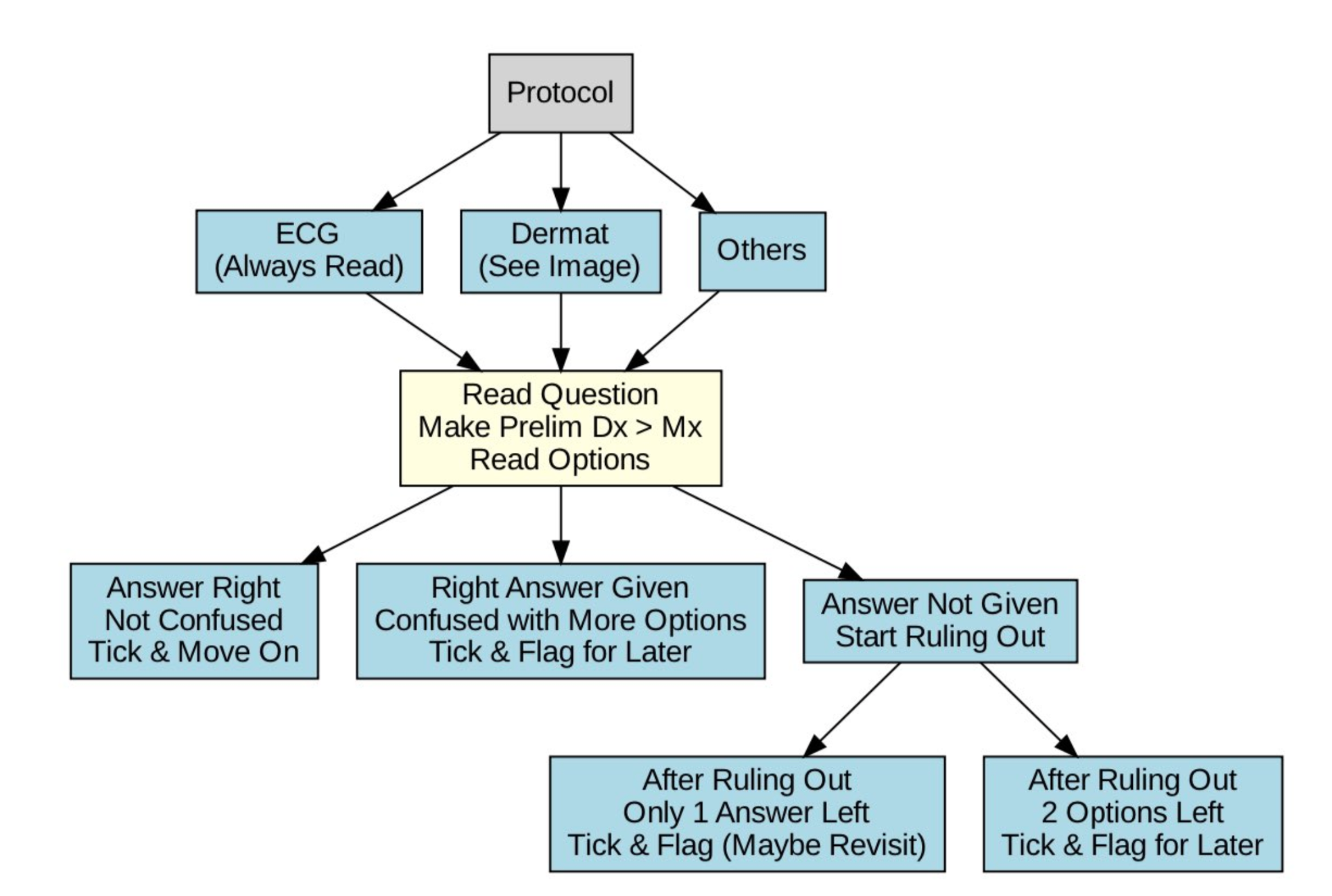
I had two students with identical NBME scores — both 255+. Same knowledge base. Same prep time. In the real exam, one scored 259. The other froze, got rattled, and missed questions due to time. The difference? One followed the MCQ protocol. The other didn't.
ALWAYS read the ECG fully before anything else. No shortcuts.
ALWAYS look at the image first, then read the question.
ALWAYS look at the lab values first before reading the question stem. Lab values tell you the diagnosis before the question does.
Read the question stem first. Standard approach.
In any question where you are confused and they ask the next best step of management — unless it is an emergency — diagnosis always comes before treatment. If it is NOT an emergency in the question and they ask you the next best step, always go for the most non-invasive and diagnostic option, not the treatment or invasive option. This single rule has saved countless decisions and questions.
Make a preliminary diagnosis (Dx) and think of the management (Mx). THEN read the options. Never let the options influence your initial thinking.
2 left → Best guess, tick, flag for later
Use your remaining time to go back to flagged questions. Review them with fresh eyes. Only change answers if you catch a clear misread.
In blocks of 20 questions in 30 minutes, you should ALWAYS have at least 3–5 minutes remaining — regardless of which NBME or which block. If you don't, your pacing needs work. Practice this during every NBME so it's automatic on exam day.
Mentality on Exam Day
- Stay calm. A few weird questions per block is NORMAL.
- Avoid getting stuck. If you freeze on one question, it rattles the next 3.
- The student who scored 259 understood this. The one who didn't — froze, got rattled, messed up the exam.
Exam Day Energy Protocol
- Drink high glucose + electrolyte drinks throughout the day
- Eat an energy bar every 3 blocks
- Practice this routine during EVERY NBME so it is automatic on exam day
- Keeping your glucose up and having a routine is ULTRA IMPORTANT
CMS Forms + NBMEs 10, 11, 12
This is where your test-taking ability gets sharpened. You now have the MCQ Protocol — apply it to every single CMS form question.
Phase 4: CMS Forms 3–6 (10–14 days)
Complete CMS Forms 3, 4, 5, and 6 for ALL systems. CMS forms are not just assessments — they are learning + assessment tools. They teach you the question patterns Step 2 uses while simultaneously testing your knowledge. You should be learning how to solve MCQs AND assessing whether you are actually getting better at it.
This entire phase should take 10–14 days for all systems.
Phase 5: NBME 10
After completing CMS Forms 3–6, take NBME 10. Same rules: offline, 20 questions per block, 30 minutes per block. You should see clear improvement from NBME 9. The CMS forms have calibrated your test-taking approach.
Phase 6: CMS Form 7 + NBME 11
7 days after NBME 10:
- Complete a full notes cycle
- Complete CMS Form 7 across all systems — 1 form per day of any system
- Give NBME 11 after 7 days
By this point you should be scoring in the 240s. If you are — your knowledge base is strong. The remaining work is refinement and consolidation.
Phase 7: CMS Forms 7–8 + NBME 12
8–9 days after NBME 11:
- Complete CMS Forms 7 and 8 for all remaining systems
- Complete a full notes cycle
- Give NBME 12 after 8–9 days
Your score might dip slightly on NBME 12 — this is normal. It's considered harder. If you're in the 240s, your knowledge is solid. Don't worry about a small drop.
AJmonics + Divine Intervention → NBME 13
Now the preparation shifts from content learning to high-yield consolidation.
AJmonics
- AJmonics videos are ~2-hour compilations of roughly 200 questions per video, per system. Available on YouTube.
- Watch them system by system. These are not short clips — they are dense, rapid-fire question review sessions.
- For every question or concept you don't know: take a screenshot. Organize these screenshots by system in a dedicated folder. This becomes one of your three final revision resources.
Divine Intervention Podcast + Marish's Notes
- If you haven't already done Divine Intervention during the consolidation phase, this is when you do it
- Go system by system through DI episodes using Marish's linked episode guides
- This fills gaps that UWorld and CMS forms may have missed — DI covers the conceptual layer that pure question practice doesn't
Complete a full notes cycle before NBME 13. AMBOSS High Yield does NOT come here. Save it for after NBME 14.
During the revision phase, Dr. High Yield's YouTube channel — Doctor High Yield MD is an outstanding resource. His revision videos are concise, high-yield, and built for rapid recall — perfect when you're consolidating before NBMEs or the real exam.
These videos are especially valuable for students who feel stuck on a score plateau or simply want to push their performance higher. Plug them into your revision rotation alongside Mehlman, DI, and AJmonics — system by system — and you'll notice gaps closing fast.
NBME 14 + AMBOSS High Yield
Phase 9: NBME 14
NBME 14 follows NBME 13. Depending on your time availability, you can either:
- Take it as a complete assessment — if you have the time, treat it like a full test day. This gives you another stamina data point before the 8-block assessments.
- Take it block by block — if you're short on time, spread the blocks across a few days alongside your review. You still get the question exposure and diagnostic value.
Complete a notes cycle before and review your weak areas from NBME 13 during this phase.
Phase 10: CMS Forms 9–10 + AMBOSS High Yield
This is where AMBOSS High Yield comes in — AFTER NBME 14, not before.
CMS Forms 9–10
- CMS Forms 9 and 10 are the newest and most exam-representative forms
- Critical strategy: Do NOT complete all of CMS Form 10. Save 20–30 questions per system from Form 10 for later. You will need MCQ practice material during and after the full assessment phase. Always have something left to practice with.
- For CMS 8, 9, and 10: make one-liner notes of every incorrect question. Write down what you got wrong and why in 1 line each. Call this your Revision Book. This book will contain small one-liners of everything that went wrong in the later CMS forms — and it becomes one of your three final revision resources.
AMBOSS High Yield Study Plans
~200 high-yield topics asked across every Step of the exam. After each system, AMBOSS gives you an analysis of which topics are weak for you. Screenshot and organize this analysis by system in a dedicated folder — just like your AJmonics screenshots.
High-yield vaccination schedules and immunization protocols tested on Step 2.
High-yield risk factor patterns — commonly tested across multiple systems.
QI and patient safety concepts tested on Step 2 CK.
Communication and professionalism scenarios — often underestimated. Complete these thoroughly.
This comes after NBME 14 because you need a solid content base before AMBOSS HY makes sense. Continue notes cycles alongside all of this.
Full Assessment Simulations
Phase 11: Full Assessment 1 — NBME 14 + NBME 15
This is your first full assessment simulating real exam conditions.
I personally don't recommend UWSA 2 as a source. Instead, combine 120 questions from NBME 14 with 200 questions from NBME 15 to create a full-length assessment of roughly 6 blocks. Some people like UWSAs — I don't. This combination gives you a more realistic exam experience using actual NBME questions.
- Complete a full notes cycle before this assessment — including your CMS Revision Book and previous NBME notes
- Review performance: identify your 3 weakest systems and dedicate targeted review before the next assessment
Phase 12: Remaining CMS 10 + NBME 16 + Free 120
Between NBME 15 and NBME 16, complete the remaining 20–30 CMS Form 10 questions per system that you saved earlier. You need to stay in MCQ-solving mode — never stop practicing. This is the material that keeps your test-taking sharp going into the final assessment.
Then take your final assessment:
- Take NBME 16 and Free 120 together as a combined 8-block session
- This is your go/no-go diagnostic — if scores are consistent with your targets, you are ready
- Med School Guru Free 120 — do this block by block leading up to the exam. Not as a full assessment. Just to go over some important concepts and keep your MCQ solving sharp.
- After this: no new content. Pure revision only.
Final Revision
No new content. No new resources. Just consolidation of everything you already know.
You have three revision resources you built throughout prep. Use all three:
Final complete cycle of your chosen notes (Annotated FA or Inner Circle Notes) which now contain your UWorld annotations AND your Mehlman Medical additions. This should be your 6th or 7th cycle by now. By this point, the notes feel like your own handwriting — you know exactly where everything is.
The one-liner notes you made from CMS Forms 8, 9, and 10 incorrects, PLUS the incorrect questions from every NBME organized by system. Go through every single one-liner. These represent every specific gap your assessments revealed.
The organized folders of screenshots from AJmonics concepts you didn't know and AMBOSS weak-topic analyses. Review all of them by system.
- AMBOSS flagged questions — every question you bookmarked or screenshotted throughout prep
- Rest properly the last 2 days
Complete 1 full cycle BEFORE every NBME. This means: go through your primary notes (full cycle) + go through your CMS + NBME Revision Book (all one-liners and incorrects) + go through your previous NBME notes if you've made any. Your notes are your single source of truth. Every cycle makes them more familiar, and that familiarity translates directly to speed and accuracy on exam day.
The Complete NBME Sequence
After knowledge consolidation — Baseline. Expect 220s–230s.
After CMS Forms 3–6 — First improvement checkpoint.
7 days after NBME 10 + CMS 7 — Expect 240s if on track.
8–9 days after NBME 11 + CMS 7–8 — May dip slightly. 240s is fine.
After AJmonics + Divine Intervention — Consolidation confirmed.
After NBME 13 — Full assessment or block-by-block (your choice).
Between NBME 14 and NBME 15 — Final CMS + AMBOSS HY. Save 20–30 Qs/system from CMS 10 for later.
Full assessment (~6 blocks) — Stamina + pacing test. No UWSA.
CMS 10 between 15 and 16, then 8-block assessment — Final go/no-go diagnostic.
Block by block leading up to exam — concept review and MCQ maintenance.
7–10 days before exam — Notes cycle + CMS Revision Book + AJ Screenshots + remaining CMS 10 Qs.
What Not to Do
The number one mistake. Students jump into UWorld without deciding on a notes set. Then they have no anchor — questions go in and knowledge leaks out. Pick your notes. Commit.
UWorld's Biostats coverage is not sufficient for Step 2. Use AMBOSS for Biostats and Ethics specifically.
If you're doing UWorld blocks without going back to your notes after every wrong answer, you're doing 50% of the work. The notes review is where retention happens.
CMS forms are a consolidation tool. If your content base isn't complete (UWorld not finished), CMS forms won't help — you'll just be guessing on questions about systems you haven't properly studied.
Same as the One-Mentor Rule for Step 1. Pick Annotated FA or Inner Circle Notes. Commit. Don't switch at month 3 because someone on Reddit recommended something else.
Students who skip their notes review before an NBME consistently score 5–10 points lower than their actual ability. The notes cycle is not optional.
250+ is doable in 4–5 months. 260+ needs 6+. I cannot give you advice on compressing beyond that. You can do it — it's just that I don't know what to advise because I have never done it.
All Resources
All resources referenced in this guide, organized by phase.
| Resource | Phase | Link |
|---|---|---|
| Marish's Annotated FA | Notes Selection — 250 track | Download → |
| Tzanki Step 2 Anki Deck | Knowledge consolidation — first 2 days of each system | Download → |
| Inner Circle Notes | Notes Selection — 260+ track | Download → |
| DI Must-Do HY Playlist PDF | If you don't have time for full DI | Download → |
| DI Episode Guides by System | Phase 2 / Phase 8 — 18 interactive HTML guides | Open Guide Library → |
| UWorld | Phase 1 — System-Wise Learning | uworld.com |
| AMBOSS | Biostats/Ethics + Phase 10 HY (200 Concepts, Vaccines, Risk Factors, QI, Communication) | amboss.com |
| Mehlman Medical | Phase 2 — Consolidation (integrate into primary notes) | YouTube |
| Divine Intervention Podcast | Phase 2 / 8 — System-wise with Marish's episode guides | YouTube / Podcast |
| CMS Forms 3–10 | Phase 4–10 — MCQ Practice + Learning + Revision Book | NBME.org |
| AJmonics | Phase 8 — ~200 Qs/video per system, screenshot unknowns | YouTube |
| NBME Forms 9–16 | Phase 3–12 — Assessments (offline, 20Q/block, 30 min) | NBME.org |
| Free 120 | Phase 12 — Full Assessment 2 (paired with NBME 16) | NBME.org |
| Med School Guru Free 120 | Block by block leading up to exam — concept review | Link TBD |
DI Episode Guides by System
18 interactive HTML guides — one per system. Download individually or download the full folder.
Other USMLE Guides
Stop guessing. Get coached.
You've read the methodology. You know what needs to happen. But if you're stuck — scores plateauing, NBMEs not moving, no clear path to your target — you don't need another guide. You need someone who's done this with 60+ students, coached a 269, and knows exactly where your prep is breaking down.
The Step 2 CK Accelerator is for students who are serious about finishing Step 2 before this match cycle — with the time and commitment to execute.
- You're aiming to complete Step 2 CK before this match season
- You have most of the day available to study — no half-effort, full commitment
If that's you — book a call. We'll audit your prep, find the gaps, and build a plan that actually gets you to your target score.
Book Your Strategy CallWritten by Dr. Marish Asudani · usmlevault.com